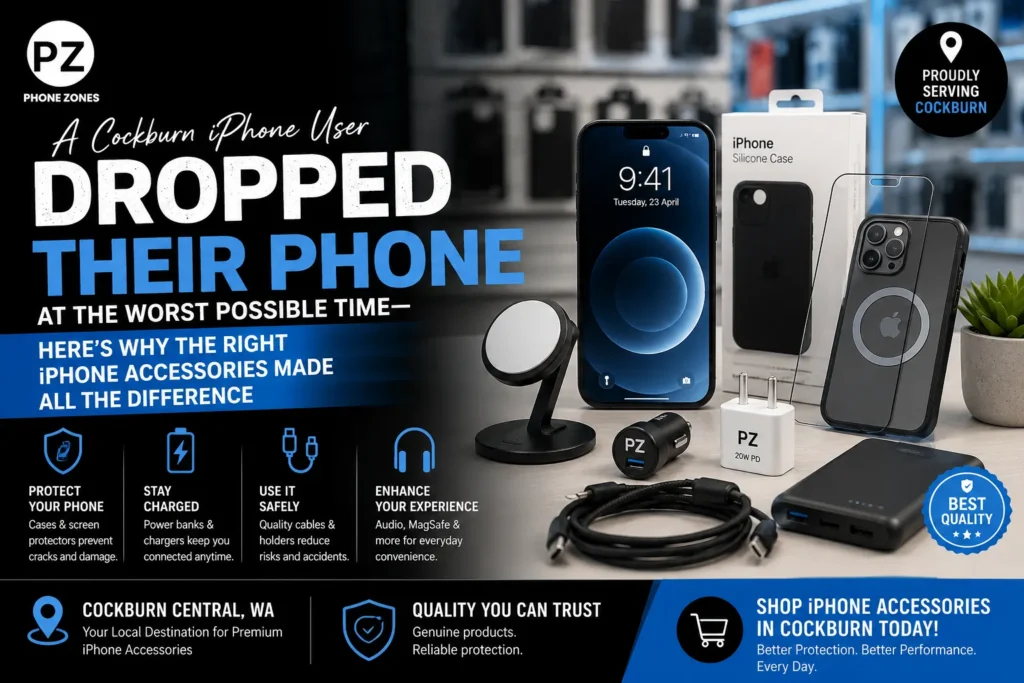
Choosing the right iPhone accessory Cockburn can be the difference between a cracked screen and a phone that walks away from a fall completely fine. This is the story of one resident’s close call, what actually saved their phone, and the accessory choices every iPhone owner in Cockburn should understand before it’s their turn to drop one.
The Drop
Sarah, a nurse doing shifts at a hospital near Cockburn Central, was basically sprinting between her car and the entrance as the night shift was just starting. Her phone slipped out from her jacket pocket, like, at the worst possible moment. It bounced and landed face-down on the concrete car park from a little over a metre, which is one of those pretty normal ways phones end up unhappy, because when it hits face down the impact goes straight into the screen area.
She’d actually had a close call with that same phone about six months earlier. Back then she’d cracked a screen protector on a kitchen tile, so yeah, it wasn’t her first rodeo. This time she’d already switched to a more solid case and screen combo, after that earlier scare. When she finally picked the phone up, bracing herself for a shattered display, the protector showed only a visible hairline crack, and the screen underneath looked totally fine, no damage at all.
Why the Outcome Was So Different the Second Time
The difference between Sarah’s two drops wasn’t luck. It came down to two specific accessory decisions made after the first incident:
A case with raised, reinforced corners. Most drops land on a corner or edge, rather than flat on the face, and corner impact is where cheaper, flat profile cases fail most often. A case with real raised lips and reinforced corner padding kinda soaks up and redirects that hit instead of just passing it right along to the glass.
A tempered glass screen protector rated for drop protection, not just scratch resistance. Not every screen protector is made exactly the same. The basic film ones usually shield against fine scratches, but they do, like, nothing much when a drop happens. A tempered glass protector that’s properly rated for impact absorption is supposed to do more than just look tough: it will crack, and kind of give itself up first, before the phone’s real display gets hit. That’s basically what went down here.
The Real Cost Comparison: Accessories vs Screen Repair
It’s worth putting the numbers next to each other, because the gap is larger than most people expect.
| Item | Typical Cost | Frequency of Need |
| Quality protective case | $30–$70 | One-time, lasts 1–2+ years |
| Drop-rated tempered glass screen protector | $20–$50 | Replaced every 6–12 months or after a crack |
| iPhone screen repair (no protection) | $150–$400+ | Per incident |
| iPhone screen replacement (severe damage) | $300–$600+ | Per incident |
A properly protected phone can survive multiple drops over its lifespan, for what feels like the price of one single unprotected screen repair. And that’s basically the whole point, the entire argument, I mean. You put money into the right accessories from day one, not treat them like optional extras you can decide later. Because yeah, the math just keeps landing on the same side.
Choosing the Right iPhone Accessories in Cockburn: What Actually Matters
Not every case or screen protector on the shelf offers meaningful protection, and price alone isn’t always a reliable guide. Here’s what to actually look for.
Cases
- Raised corners and camera bump protection. Corners take the brunt of most falls, and an exposed camera module is one of the most commonly damaged points on newer iPhones.
- Shock-absorbing material, not just a hard shell. A rigid case that doesn’t flex can transfer impact straight through to the phone. Look for cases combining a firm outer shell with a softer inner liner.
- MagSafe compatibility, if you use wireless charging or magnetic accessories, since non-compatible cases can weaken charging alignment and speed.
- Drop-rating certification. Many reputable case manufacturers publish military-standard (MIL-STD-810G) drop test ratings, a useful, objective way to compare products beyond marketing claims.
Screen Protectors
- Tempered glass over plastic film for genuine impact absorption, not just scratch resistance.
- Correct hardness rating (9H or higher) for meaningful scratch and crack resistance.
- Edge-to-edge coverage matching your specific iPhone model, since gaps at the edges are a common failure point in falls.
- Case-friendly fit, so the protector doesn’t lift or peel at the edges where it meets your case.
Other Accessories Worth Considering
- A grip-enhancing case or ring holder, since a large share of drops happen from a phone simply slipping out of hand, not from a bag or pocket.
- A crossbody or wrist strap accessory for anyone frequently moving between locations, like tradespeople, healthcare workers, or parents managing kids and bags simultaneously.
- A car mount or dock, reducing the number of times a phone is handled loosely while driving or getting in and out of a vehicle.
Safety Tips to Reduce the Risk of a Damaging Drop
Accessories reduce the consequences of a drop, but a few habits reduce how often it happens in the first place.
- Avoid carrying your phone in shallow or open pockets, particularly jacket pockets without a zip or button closure, which is exactly how Sarah’s phone slipped out the first time.
- Use a secure grip or ring holder if you frequently walk while using your phone, since single-hand fumbling is one of the most common drop scenarios.
- Set your phone down deliberately rather than tossing it onto furniture, since soft-surface drops that bounce onto a hard edge cause a surprising number of screen cracks.
- Be extra cautious in transitional moments — getting in and out of a car, walking through doorways, or reaching into a bag when a phone is most likely to slip unnoticed.
- Check your case and screen protector condition every few months. A worn, lifted, or cracked protector loses much of its protective value and should be replaced before it fails when you actually need it.
- Consider your work environment. Tradespeople, healthcare workers, hospitality staff, and anyone frequently moving quickly between tasks face higher drop risk and should choose accessories rated for heavier-duty protection accordingly.
What to Do If Your Screen Cracks Despite Protection
Even with a good case and screen protector, a hard enough impact can still cause damage. If that happens:
- Stop using the phone if the glass is visibly shattered, since sharp edges pose a real injury risk and continued use can worsen internal damage.
- Check whether the damage is limited to the protector. If your screen protector absorbed the impact, replacing just the protector may be all that’s needed.
- Get a proper diagnostic assessment before assuming a full screen replacement is required. Sometimes only the glass layer is affected while the underlying display remains functional, which can mean a simpler and cheaper repair.
- Back up your phone as soon as possible after any drop, even if it still appears to work normally, in case underlying damage affects functionality later.
Industry Trends in iPhone Accessories for 2026
Drop-test transparency is becoming a genuine purchasing factor. More buyers are checking published MIL-STD-810G ratings before choosing a case, rather than relying on marketing language like “military grade” without supporting data.
MagSafe-integrated accessory ecosystems are expanding rapidly, with cases, wallets, car mounts, and charging accessories increasingly designed to work together rather than as standalone purchases.
Repairable and sustainable case materials are gaining traction, as more consumers factor in recyclability and longevity alongside protection level when choosing accessories.
Screen protector technology is closing the gap with case protection, with newer tempered glass products offering meaningfully better shock absorption than the scratch-focused protectors common a few years ago.
Workplace-specific accessory demand is rising, particularly among healthcare, trade, and hospitality workers who need heavier-duty protection suited to fast-paced, high-risk environments exactly the profile that led to Sarah’s second, much better outcome.
Why Cockburn Residents Choose Phonezones for iPhone Accessories
Sarah’s story is kind of common, the first drop is often the wake-up call, and the second is where the right accessory is actually getting tested. At Phonezones, we help Cockburn customers pick cases and screen protectors matched to how they genuinely use their phone, not just what’s cheapest sitting on the shelf. So the next drop turns into a non-event rather than that costly repair, which nobody really wants.
Frequently Asked Questions
Look for a case with raised, reinforced corners, shock-absorbing inner material, and ideally a published military-standard drop rating (MIL-STD-810G), which provides an objective benchmark beyond marketing claims.
A quality tempered glass screen protector rated for impact, not just scratch resistance, is designed to crack and absorb impact before the phone’s actual screen does. Basic plastic film protectors offer far less drop protection.
Most tempered glass protectors should be replaced every 6–12 months, or immediately after any visible crack, chip, or lifting at the edges, since damaged protectors lose much of their protective value.
Price alone isn’t a reliable indicator of protection quality. A mid-range case with a published drop-test rating and reinforced corners often outperforms a more expensive case without those features, so it’s worth checking specifications rather than price alone.
Not necessarily. If the protector absorbed the impact, the phone’s screen underneath may be completely intact, as in Sarah’s case. It’s still worth a quick check, since some cracks can affect touch sensitivity even without visible screen damage.
Check for visible cracks, test touch responsiveness and camera function, and back up your data as soon as possible in case underlying damage affects the phone later, even if it initially appears fine.
If there’s any chance you’ll use MagSafe chargers, mounts, or wallets in future, a MagSafe-compatible case avoids needing to replace your case later and typically doesn’t cost significantly more than a non-compatible option.
Rugged, heavy-duty cases do add bulk compared to slim options, which is a genuine trade-off. Many manufacturers now offer mid-tier options balancing meaningful drop protection with a slimmer profile, worth trying in person before committing.
A face-down drop concentrates the full impact directly on the screen, the most fragile component of the phone, whereas drops landing on the back or a corner distribute force differently and are often more survivable with the right case.
Yes. Our Cockburn store can assess your specific iPhone model and usage habits to recommend a case and screen protector combination suited to your actual risk of drops, rather than a generic one-size-fits-all option.
Self-installed screen protectors are prone to trapped air bubbles, dust particles under the glass, and misalignment at the edges, all of which reduce both clarity and protective effectiveness. In-store fitting is typically done in a controlled, dust-minimised environment with alignment tools, giving a cleaner result and often a warranty against installation defects.
Sarah’s second drop cost her nothing beyond a $25 screen protector replacement. Her first cost her a full screen repair. The lesson isn’t really about luck at all. It’s that the right accessories, chosen properly and replaced when worn, do exactly what they’re designed to do at the exact moment you need them to.
Get the Right Protection Today
Don’t wait for your own worst-possible-timing moment. Visit Phonezones in Cockburn for iPhone accessories genuinely built to protect your phone, matched to how you actually use it every day.